Machine Learning
NSL in TensorFlow
A new framework by TensorFlow to train neural networks with structured signals
As AI penetrates all industries, Advancement will be no exception. At its heart, Advancement possesses similar challenges to any business. For this reason, Advancement departments can benefit from many of the new and exciting technologies used by other businesses. Learn more
The top performing nonprofits and Advancement departments are already using AI to improve the returns on their fundraising efforts–and an increasing number of organizations are joining them (Learn more). For good reason. AI has consistently succeeded in providing dramatic improvements in results across all industries.
Today, a university has to compete with over 1.2 million equally worthy causes that its alumni can give their limited charitable dollars to. Moreover, megatrends such as declining participation rates, generational changes in attitudes towards giving, and tax code changes that are also having a materially negative impact on fundraising. In an increasingly competitive and challenging fundraising environment, maintaining the status quo is not an option.
CueBack is at the forefront of applying AI to Advancement to increase predictability, minimize cost, and maximize giving.
Learn more about machine learning and its benefits to your needs.
A new framework by TensorFlow to train neural networks with structured signals
An open source machine learning system focused on training deep neural networks
Extreme Learning Machine, a neural network with a faster learning rate
Creating recommendations as a service and lessons learned for future ML services
AI technology enables Advancement to scale its operations by optimizing resources to maximize return. Predictive analytics can identify and qualify low value transactional donors that only require low touch outreach, such as phonathons. Meanwhile, Advancement can focus its most precious resource-its Major, Principal, and Planned Gift Officers-on high value donors who require a high touch strategy. AI can provide the insights needed to help cultivate the deeply personal relationships with these donors that generate the largest financial returns for the university.
CueBack’s predictive analytics helps universities unlock hidden insights within their data so they can do the following:
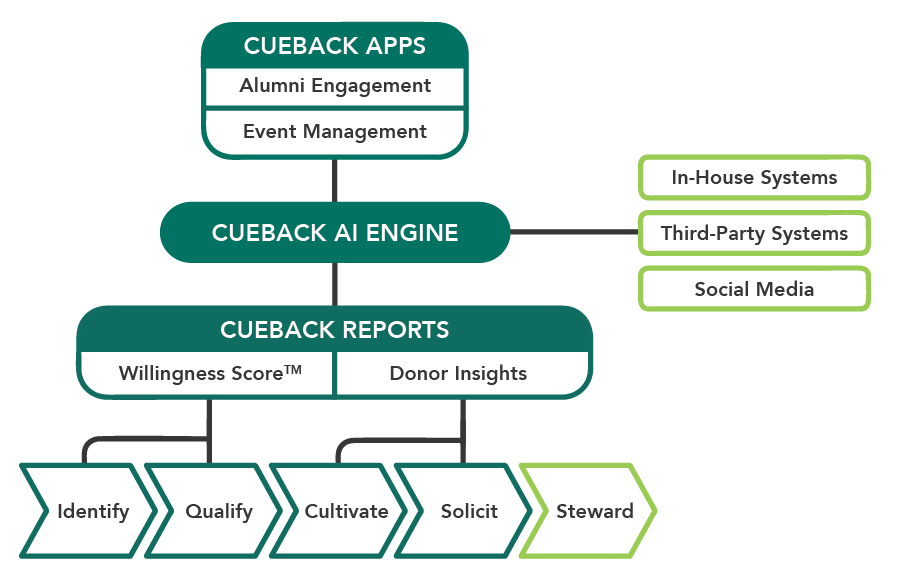
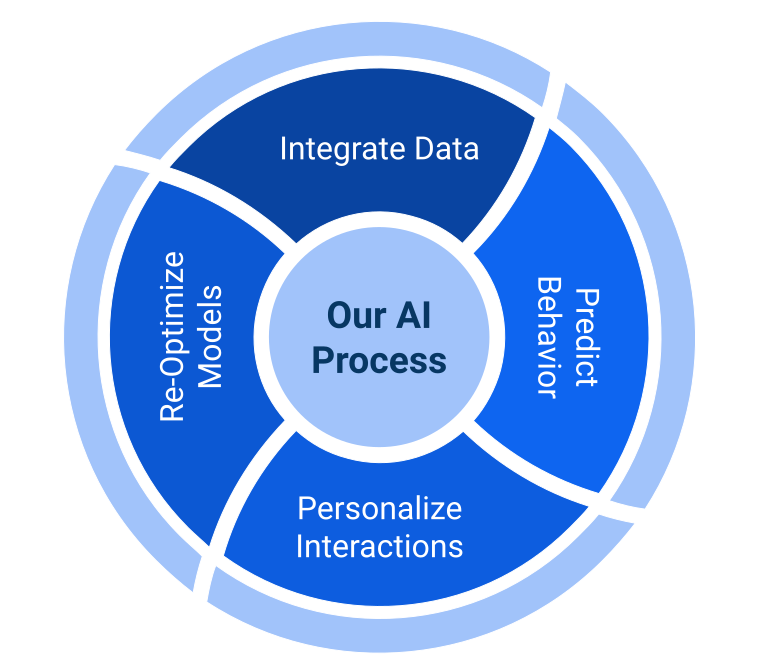
CueBack’s AI process can be summarized into 4 steps: Integrate Data, Predict Behavior, Convert to Donors, and Re-optimize Models.
The first step of the process is to align your existing donor information. Donor data from all sources across your organization, including databases, spreadsheets, and social media, can be integrated into a single solution.
Then, we marry your existing data with quantitative and qualitative data generated by your alumni through CueBack’s engagement and event management applications. This enables you to have a complete view of each alumni and your alumni base as a whole.
CueBack’s predictive model uses the consolidated data to segment and score donors in order to determine the likelihood, size and timing of donations.
Now that you know which prospective donors to cultivate and how to allocate your resources, you need to define your cultivation strategies. For your high value alumni, there is no substitute for person-to-person interactions. The personal touch is the foundation for building the deep, long-term relationships that underpin all fundraising activities. CueBack’s AI engine provides you with deep insights about your alumni to help you build that rapport and trust. Learn more
The AI process is not linear. CueBack’s AI Engine continuously uses real-time feedback from ongoing advancement and engagement activities to learn and improve its predictions and insights.
Learn about the benefits you can gain from implementing predictive AI.
Practical insights from creating a deep candidate generation model & a separate deep ranking model
Effects of varying configurations and hyper-parameters on two different types of neural networks
Why predictive analysis should be incorporated into information systems research and how to accomplish it
Using predictive analysis to improve the effectiveness and quality of ads
CueBack’s unique alumni engagement and advancement strategy has been built from the ground up to fully employ the power of AI, machine learning and predictive analytics. During the design phase, we made fundamental decisions to ensure we did not just capture more data than other platforms, but that we uniquely tracked how alumni relate to each other, their affinities, and your university. The quantitative and qualitative alumni data that we capture provides the most detailed and comprehensive dataset to fully harness the power and benefits of AI.
To learn more about how CueBack’s AI engine and predictive analytics can help your university achieve its fundraising goals, contact us for a demo.
How predictive analytics can be applied to big data and make recommendations called prescriptive analytics
An example of how predictive analytics is used to determine a retention score
A review of machine learning algorithm foundations and implementations with R and Python.
TensorFlow is flexible and computations expressed on it can be used on a plethora of devices
Predictive analytics uncovers patterns, trends, and associations hidden within all types of data to help predict future outcomes, solve problems and guide smarter decisions.
Many businesses across many industries use predictive analytics to understand their customers and build stronger, more profitable relationships. These capabilities are also used by nonprofit organizations to gain similar benefits with their donors.
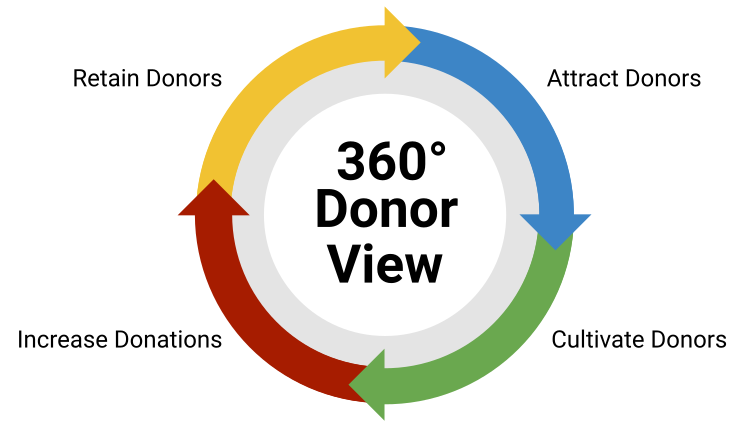
Predictive analytics uses advanced algorithms to analyze donor data and deliver a 360-degree view of individual donors. These analytic results provide detailed insight into the needs, preferences and behaviors of donors. Predictive models can be created which enable colleges to anticipate how donors will respond to certain campaigns, which contribution amounts they would be likely to give, when they should be solicited versus when they should be left alone, which communication channels they prefer, and much more.
By deploying these insights to gift officers and frontline systems such as phonathons and email solicitation, colleges can significantly increase the effectiveness of donor campaigns and strategies. And because predictive analytics learns from every donor interaction, it can also help to build more loyal relationships over time and provide an “early warning system” of donors that may be dissatisfied and require extra attention.
Predictive analytics also helps colleges prioritize their resources based on anticipated returns and thereby reduce the costs of donor management. Colleges can determine which donor targets, messages and channels will yield the best results. The wasted effort and expense of low yield donor processing and correspondence can be minimized.
Advancement professionals can only succeed if they have good information.
At the heart of AI’s power lies data. Lots of it. High quality, diverse, relevant. Without good data, AI just doesn’t work.
CueBack’s uniqueness lies in the breadth and depth of the data it captures and analyzes about your alumni, like how they engage with your university, and how they engage with each other.
CueBack has taken a fundamentally different approach to the AI data challenge. By capturing and monitoring detailed data about all aspects of alumni activity, CueBack is the only advancement platform that combines full-service social engagement activity with advanced advancement analytics.
CueBack’s in-depth data model supports extensive data mining and analysis within a single platform–a potent approach when aiming to improve advancement activities as fast and effectively as possible.
As a Gift Officer, you are no longer dependent on shallow external engagement metrics from third party social media platforms–such as ‘likes’ and ‘follows’ on Facebook. You can now have a real solid measure of alumni engagement that tells you more about your alumni than you ever thought possible. You own the engagement environment. You have direct access to all important meta-data. Your engagement and advancement metrics are more detailed, more sophisticated and, most importantly–under your direct control.